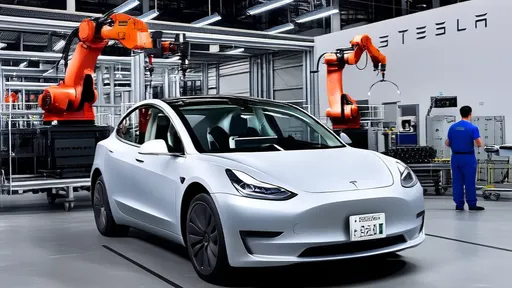
Tesla's Shanghai Gigafactory has long been the crown jewel of the company's global manufacturing strategy, serving as both an export hub and a key supplier for the Chinese market. Now, with its latest expansion plans, the facility is poised to take on an even more significant role—this time as the production base for the highly anticipated Model 2, a budget-friendly electric vehicle (EV) designed specifically for emerging markets. The move signals Tesla's aggressive push to capture demand in regions where affordability and local production are critical to success.
The expansion of the Shanghai plant comes at a time when Tesla is facing increasing competition from Chinese EV makers like BYD, NIO, and XPeng, all of which have been rolling out cheaper models to dominate their home market. By doubling down on production capacity in Shanghai, Tesla is not only reinforcing its commitment to China but also positioning itself to leverage the country's cost-efficient supply chain for global exports. The Model 2, rumored to be priced below $25,000, could be a game-changer in markets such as Southeast Asia, Latin America, and Eastern Europe, where price sensitivity remains a major barrier to EV adoption.
Industry analysts suggest that Tesla's decision to dedicate the Shanghai facility to the Model 2 for emerging markets is a calculated bet. Unlike North America and Western Europe, where Tesla's brand prestige and higher-end models like the Model 3 and Model Y dominate, developing economies require a different approach. Localized production reduces import tariffs and logistics costs, making the vehicle more competitive against regional rivals. Additionally, China's well-established battery and component ecosystem allows Tesla to keep production expenses low without sacrificing scale.
Beyond cost considerations, Tesla's strategy also reflects the growing importance of emerging markets in the global EV transition. While wealthier nations have led the charge in electrification, the next wave of growth is expected to come from countries with rapidly urbanizing populations and increasing middle-class demand for personal vehicles. By introducing an affordable, mass-market EV, Tesla aims to replicate the success it has seen in China—where locally built vehicles helped the company secure a dominant position—in other high-potential regions.
However, challenges remain. Emerging markets often lack the charging infrastructure and government incentives that have accelerated EV adoption in developed economies. Tesla may need to collaborate with local governments and private players to build out charging networks, or even adapt its business model to include battery-swapping solutions, as some Chinese automakers have done. Furthermore, political and economic instability in certain regions could pose risks to Tesla's expansion plans.
Despite these hurdles, Tesla's Shanghai expansion and the focus on the Model 2 underscore the company's ambition to be a truly global automaker. If successful, the move could democratize access to EVs in markets that have long been overlooked by traditional automakers, further solidifying Tesla's position as the leader in the electric revolution.

By /Aug 12, 2025

By /Aug 12, 2025
By /Aug 12, 2025
By /Aug 12, 2025
By /Aug 12, 2025

By /Aug 12, 2025

By /Aug 12, 2025

By /Aug 12, 2025
By /Aug 12, 2025

By /Aug 12, 2025

By /Aug 12, 2025

By /Aug 12, 2025

By /Aug 12, 2025

By /Aug 12, 2025

By /Aug 12, 2025

By /Aug 12, 2025

By /Aug 12, 2025
By /Aug 12, 2025

By /Sep 15, 2025

By /Aug 12, 2025