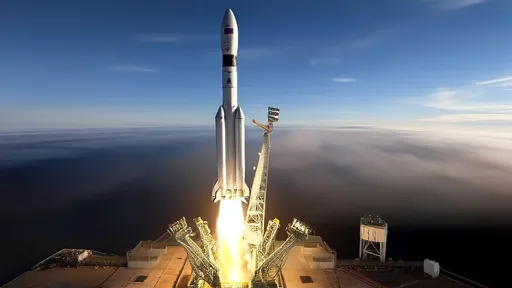
The recent successful commercial launch of SpaceX's Starship has sent ripples through the global satellite internet industry, marking a pivotal moment in the race to dominate space-based connectivity. With this milestone, Elon Musk's aerospace company has not only demonstrated the viability of its colossal rocket but also signaled its intent to aggressively expand its Starlink constellation. The implications for competitors, from established players like OneWeb to emerging challengers such as Amazon's Project Kuiper, are profound. The stakes have never been higher in this high-orbit showdown where technological prowess, regulatory maneuvering, and sheer launch capacity will determine who controls the final frontier of digital infrastructure.
What makes this Starship mission particularly consequential is its payload capacity—reportedly over 100 metric tons to low Earth orbit (LEO). This brute-force capability allows SpaceX to deploy satellites at an unprecedented pace, potentially adding hundreds of Starlink units per launch. Industry analysts note that while Falcon 9 has been the workhorse building the current 5,000-satellite constellation, Starship could exponentially accelerate deployment toward the eventual target of 42,000 units. "This isn't just incremental improvement," remarked a veteran satellite communications engineer who requested anonymity due to corporate policies. "We're witnessing a paradigm shift where a single launch might carry more satellites than some competitors' entire initial constellations."
The competitive landscape is reacting swiftly. Amazon recently secured additional Atlas V and Vulcan Centaur rockets from United Launch Alliance (ULA) to fast-track Project Kuiper's deployment after years of delays. Meanwhile, OneWeb has been leveraging its partnership with Arianespace and the Indian Space Research Organisation (ISRO) to rebuild its launch cadence following the rupture with Roscosmos after Russia's invasion of Ukraine. Chinese competitors like Galaxy Space are also advancing, though largely focused on domestic markets due to geopolitical constraints. What unites these players is the recognition that SpaceX's vertical integration—from rocket manufacturing to satellite production to launch operations—gives it structural advantages that traditional aerospace models struggle to match.
Regulatory battles are intensifying alongside the technological race. The Federal Communications Commission (FCC) faces mounting pressure to update spectrum allocation frameworks originally designed for far smaller constellations. SpaceX has petitioned for modifications to its Gen2 Starlink network authorization, while competitors argue such changes would create harmful interference. Similar debates rage internationally, with the International Telecommunication Union (ITU) working to prevent orbital crowding and signal overlap. "The rules were written assuming maybe a few dozen satellites per operator," explained a Geneva-based spectrum policy advisor. "Now we're discussing systems an order of magnitude larger, with collision risks and light pollution concerns that keep astronomers and safety experts awake at night."
Market dynamics add another layer of complexity. Starlink has demonstrated the viability of direct-to-consumer satellite internet, amassing over 2.3 million subscribers globally. However, profitability remains elusive due to steep user terminal costs and launch expenses—challenges Starship could mitigate through economies of scale. Enterprise and government contracts are becoming the next battleground, with SpaceX securing Pentagon deals for secure communications while OneWeb positions itself as the preferred partner for sovereign networks. The maritime and aviation sectors have emerged as particularly lucrative verticals, with cruise lines and airlines racing to offer broadband at sea and in-flight.
Technological differentiation is accelerating across three key vectors: satellite sophistication, ground infrastructure, and orbital strategy. Next-generation satellites now feature laser interlinks (like Starlink's V2 Mini models) that reduce reliance on ground stations. Amazon's prototype Kuiper satellites recently demonstrated 400 Mbps speeds in tests, while startups like Astranis focus on compact geostationary satellites serving specific regions. On the ground, user terminal costs have fallen from thousands to hundreds of dollars, though further reductions are needed for mass adoption in developing markets. Orbital strategies are also diverging—while most operators concentrate on LEO, some are experimenting with very low Earth orbit (VLEO) for reduced latency or medium Earth orbit (MEO) for wider coverage.
The environmental impact of mega-constellations is sparking intense debate. Astronomers warn that tens of thousands of satellites could fundamentally alter ground-based astronomy, despite mitigation efforts like Starlink's VisorSat sunshades. Reentry risks from defunct satellites and the long-term sustainability of orbital traffic are drawing scrutiny from environmental groups and policymakers alike. SpaceX maintains that its satellites are 95% demisable upon reentry and points to their role in connecting remote areas without terrestrial infrastructure. However, the European Space Agency is spearheading efforts to develop stricter space sustainability standards that could reshape industry practices.
Looking ahead, the satellite internet industry appears poised for both explosive growth and inevitable consolidation. Investment analysts project the global satellite broadband market could exceed $18 billion by 2030, but question whether more than two or three operators can achieve profitability. SpaceX's Starship advantage—if fully realized—might allow Starlink to capture dominant market share, though regulatory interventions or technological breakthroughs from competitors could alter the trajectory. What's certain is that the coming decade will transform how humanity accesses the internet, with space becoming an extension of our digital infrastructure much as fiber-optic cables crisscross the ocean floors today.
Behind the technical and business challenges lies a more philosophical question about the governance of space-based internet. As private companies deploy infrastructure that could eventually serve billions, issues of digital sovereignty, content moderation, and equitable access take on extraterrestrial dimensions. The Outer Space Treaty of 1967 established that no nation could claim celestial bodies, but said little about corporations controlling the pathways between them. This legal gray area is becoming increasingly contentious as satellite internet blurs traditional telecommunications boundaries.
The human dimension of this competition often gets overlooked. In rural Alaska, Starlink has enabled telehealth services previously impossible over sluggish connections. Pacific island nations use satellite internet to maintain contact across thousands of miles of ocean. Ukrainian forces leveraged Starlink terminals when terrestrial networks were destroyed. These use cases underscore why the stakes transcend corporate profits—connectivity has become synonymous with opportunity, security, and sometimes survival. As the satellite internet race accelerates, its ultimate measure of success may not be in megabits per second or quarterly subscriber numbers, but in how effectively it bridges our world's persistent digital divides.

By /Aug 12, 2025

By /Aug 12, 2025

By /Aug 12, 2025

By /Aug 12, 2025

By /Aug 12, 2025

By /Aug 12, 2025

By /Aug 12, 2025

By /Aug 12, 2025
By /Aug 12, 2025

By /Aug 12, 2025

By /Aug 12, 2025

By /Aug 12, 2025

By /Aug 12, 2025

By /Aug 12, 2025

By /Aug 12, 2025

By /Aug 12, 2025

By /Aug 12, 2025

By /Aug 12, 2025

By /Sep 15, 2025

By /Aug 12, 2025