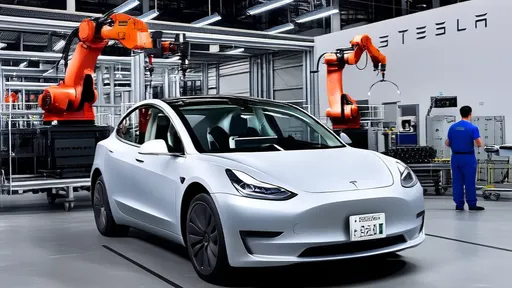
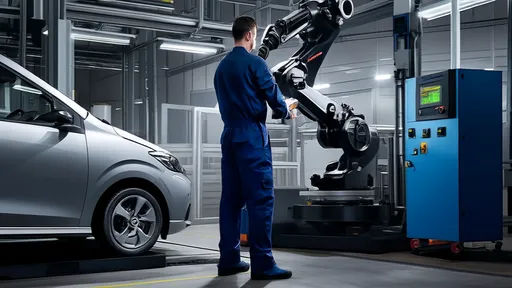
The once-booming Chinese automotive market, long considered the crown jewel of global car manufacturers, is witnessing a surprising exodus of German automakers. Companies like Volkswagen, BMW, and Mercedes-Benz are quietly but decisively shifting their production bases away from China, opting instead for new manufacturing hubs in Eastern Europe and Mexico. This strategic realignment marks a significant turning point in the global automotive industry and reflects deeper geopolitical and economic undercurrents reshaping international trade patterns.
For decades, China served as an irresistible magnet for German automotive investment. The promise of a burgeoning middle class with an appetite for premium vehicles, coupled with relatively low production costs, made the Asian giant an obvious choice for expansion. However, recent years have seen a perfect storm of challenges that have forced German executives to reconsider their China-first approach. Rising labor costs, stringent local data laws, and an increasingly unpredictable regulatory environment have all contributed to growing unease among foreign investors.
The geopolitical landscape has perhaps played the most decisive role in this strategic shift. As tensions between China and Western nations escalate, German automakers find themselves caught in the crossfire of what many analysts describe as a new Cold War. The risk of sudden sanctions or supply chain disruptions has become too significant to ignore. "We can no longer afford to have all our eggs in one basket, especially when that basket sits on increasingly shaky ground," confided a senior executive from a major German automaker who requested anonymity due to the sensitivity of the matter.
Eastern Europe has emerged as a particularly attractive alternative for German manufacturers. Countries like Hungary, Poland, and the Czech Republic offer several compelling advantages. Their proximity to Germany's headquarters and established supplier networks allows for greater operational efficiency and shorter lead times. Additionally, these nations provide a skilled workforce at competitive wages, along with business-friendly governments eager to attract foreign investment. BMW's recent billion-euro investment in a new Hungarian plant and Mercedes' expansion of its Kecskemét facility underscore this growing trend.
Meanwhile, across the Atlantic, Mexico presents another viable option for German automakers looking to diversify their production footprint. The North American country's strategic location provides easy access to both the U.S. market and Latin America, while its participation in the USMCA trade agreement eliminates many tariff barriers. Volkswagen has already announced plans to significantly ramp up production at its Puebla plant, with a particular focus on electric vehicles destined for the American market. "Mexico gives us the perfect springboard to serve our most important market while maintaining cost competitiveness," explained a VW spokesperson.
The transition won't be without its challenges. Establishing new supply chains and training workforces in unfamiliar territories requires substantial time and capital investment. Some analysts caution that the shift could temporarily impact profit margins and production efficiency. However, most industry observers agree that the long-term benefits of diversification outweigh these short-term pains. "This isn't just about chasing lower wages anymore," noted automotive industry expert Klaus Schmidt. "It's about building resilience into their global operations to weather whatever political or economic storms may come."
Chinese officials have downplayed the significance of these moves, insisting that the country remains open for business and committed to foreign investment. However, behind the scenes, there appears to be growing concern about the potential ripple effects. The departure of prestigious German brands could influence other foreign manufacturers to reconsider their China strategies, potentially triggering a broader exodus of automotive investment.
For German automakers, the calculus has fundamentally changed. Where once they saw unlimited growth potential in China, they now perceive unacceptable levels of risk. Their pivot toward Eastern Europe and Mexico represents more than just a geographical shift—it signals a profound transformation in how global corporations approach international expansion in an era of heightened geopolitical tensions and economic uncertainty. As one industry insider put it: "The rules of the game have changed, and we're simply adapting to survive."
The coming years will reveal whether this strategic gamble pays off. What's certain is that the global automotive map is being redrawn, with production centers shifting in response to the new realities of international commerce. For German automakers, the race is on to establish their new bases of operations before the next wave of disruptions hits. The companies that navigate this transition successfully may well emerge stronger and more resilient than ever before.

By /Aug 12, 2025

By /Aug 12, 2025
By /Aug 12, 2025
By /Aug 12, 2025
By /Aug 12, 2025

By /Aug 12, 2025

By /Aug 12, 2025
By /Aug 12, 2025
By /Aug 12, 2025

By /Aug 12, 2025

By /Aug 12, 2025

By /Aug 12, 2025

By /Aug 12, 2025
By /Aug 12, 2025

By /Aug 12, 2025

By /Aug 12, 2025

By /Aug 12, 2025
By /Aug 12, 2025

By /Sep 15, 2025

By /Aug 12, 2025