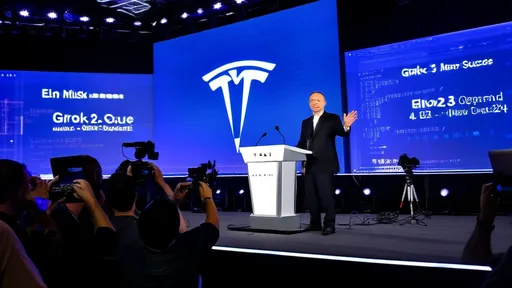
In a move that sent ripples through the artificial intelligence community, Elon Musk's xAI has officially open-sourced its Grok-2.5 model. The announcement, made via a series of posts on the X platform, marks a significant strategic pivot for the company, placing it firmly in the growing camp of open AI development. This decision is not an isolated event but part of a broader, more ambitious roadmap, with Musk boldly declaring that the more powerful Grok-3 model will follow suit and be released to the public within the next six months.
The unveiling of Grok-2.5's weights and architecture provides researchers and developers worldwide with unprecedented access to a state-of-the-art large language model. This level of transparency is rare among leading AI firms, which have traditionally guarded their most advanced technologies as proprietary secrets. By opening the kimono, xAI is effectively inviting global scrutiny, collaboration, and innovation atop its foundational technology. Developers can now download, modify, and deploy Grok-2.5 for a wide range of applications, from academic research to commercial products, without restrictive licensing fees.
Elon Musk's rationale for this open-source strategy appears multifaceted. Publicly, he has consistently framed advanced AI as a profound existential risk to humanity, arguing that its development should not be confined to a handful of powerful, closed-door corporations like Google or OpenAI. Making xAI's models open source is pitched as a democratizing force, a way to distribute power and prevent a dangerous concentration of AI capability. It aligns with his long-stated belief that for humanity to safely navigate the AI revolution, the technology must be widely understood and accessible, not shrouded in corporate secrecy.
However, industry analysts are quick to point out the sharp competitive undertones of this move. By open-sourcing Grok-2.5 and its successor, xAI is leveraging the collective power of the global developer community to rapidly iterate, improve, and find novel applications for its technology—a process that would be much slower and more costly if undertaken solely in-house. This creates a powerful ecosystem around xAI's models, potentially allowing it to catch up to and even surpass rivals through crowd-sourced innovation. It is a classic play: commoditize the model to amplify its reach and influence, thereby strengthening the position of the underlying platform and its associated services.
The technical specifications of Grok-2.5 itself have garnered significant attention. Early benchmarks suggest it is a formidable competitor to other leading open-source models like Meta's Llama 3. It demonstrates particular strength in complex reasoning, coding assistance, and creative tasks, while its unique selling point remains its deep integration with real-time data from the X platform. This allows Grok to provide insights and responses that are more current and contextually aware of real-world events than many of its competitors, which often rely on static training datasets with cut-off dates.
Looking ahead, the promise of Grok-3 looms large. Musk's announcement that this next-generation model will be open-sourced within half a year has set a new benchmark for pace in the industry. It signals an incredibly aggressive development timeline for xAI, suggesting the company is confident in its architectural advancements and training methodologies. The AI community is now watching closely, eager to see if the company can deliver on this ambitious promise and what leap in performance Grok-3 will represent. Will it be a mere incremental improvement, or a generational shift that redefines the open-source landscape?
Reactions from across the tech sector have been mixed but largely intense. The open-source community has welcomed the news with enthusiasm, celebrating the injection of a high-quality model into their toolkit. Many developers and startups see it as a game-changer, lowering the barrier to entry for building sophisticated AI-powered applications. Conversely, some competitors and safety advocates have expressed concern. They worry that releasing such powerful models without safeguards could accelerate the proliferation of malicious uses, including sophisticated disinformation campaigns, automated cyberattacks, and personalized phishing schemes.
This strategic gambit by xAI also raises profound questions about the future of AI business models. If a company can give away its core product for free, how does it intend to generate revenue? For xAI, the answer likely lies in a platform strategy. By establishing Grok as a ubiquitous standard, the company can monetize through premium, hosted API services, specialized enterprise features, and deeper integrations with Musk's other ventures, such as X, Tesla, and SpaceX. The model itself becomes a loss leader for a suite of valuable services built around it.
In conclusion, Elon Musk's decision to open-source Grok-2.5 and pledge the same for Grok-3 is far more than a simple product release. It is a strategic cannonball into the deep end of the AI pool, challenging the prevailing norms of proprietary development and intensifying the war for AI dominance. It is a bet that transparency and community-driven development will ultimately yield a safer, more robust, and more widely adopted AI than any closed system could produce. Whether this move will be remembered as a visionary step towards democratizing AI or a risky acceleration of its dangers remains one of the most compelling narratives to watch in the technology world today.
By /Aug 27, 2025
By /Aug 27, 2025

By /Aug 27, 2025

By /Aug 27, 2025
By /Aug 27, 2025

By /Aug 27, 2025

By /Aug 27, 2025

By /Aug 27, 2025
By /Aug 27, 2025

By /Aug 27, 2025
By /Aug 27, 2025

By /Aug 27, 2025
By /Aug 27, 2025

By /Aug 27, 2025

By /Aug 27, 2025

By /Aug 27, 2025
By /Aug 27, 2025
By /Aug 27, 2025

By /Aug 27, 2025
By /Aug 27, 2025