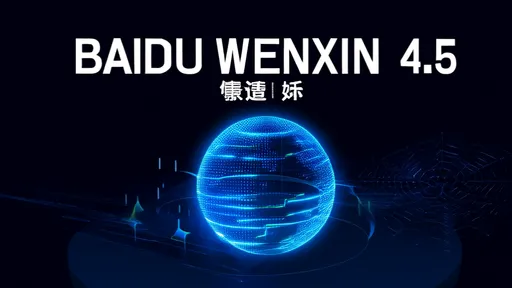
In a groundbreaking move that is set to reshape the landscape of artificial intelligence, Baidu has globally launched and open-sourced its Wenxin 4.5 series models. This strategic release not only underscores Baidu's commitment to advancing AI technology but also democratizes access to state-of-the-art multimodal capabilities for developers and researchers worldwide. The announcement has sent ripples across the tech community, positioning Baidu at the forefront of the intensifying global AI race.
The Wenxin 4.5 series represents a significant leap forward in multimodal AI, achieving unprecedented performance on comprehensive benchmark tests. According to Baidu's extensive evaluations, the models have reached State-of-the-Art (SOTA) levels across a multitude of tasks, including but not limited to image recognition, natural language understanding, audio processing, and cross-modal reasoning. This holistic excellence demonstrates a robust and versatile architecture capable of understanding and generating content that seamlessly integrates text, images, and sound.
What sets the Wenxin 4.5 series apart is its remarkable proficiency in handling complex, real-world scenarios that require a deep synthesis of information from different modalities. For instance, the model can accurately generate detailed textual descriptions from intricate visual data, answer nuanced questions based on a combination of image and text inputs, and even create coherent narratives that weave together auditory and visual cues. This level of performance is not merely an incremental improvement but a substantial advancement that narrows the gap between AI capabilities and human-like comprehension.
Baidu's decision to open-source these powerful models is a strategic and generous contribution to the global AI ecosystem. By making the Wenxin 4.5 series accessible to the public, Baidu is empowering a vast network of developers, startups, and academic institutions to build upon this technology. This move is expected to accelerate innovation across various sectors, including healthcare, where multimodal AI can assist in diagnosing diseases from medical images and reports; education, through the creation of more interactive and personalized learning tools; and entertainment, by enabling the development of richer, more immersive content.
The technical architecture behind the Wenxin 4.5 series is a testament to years of dedicated research and development. It leverages a sophisticated transformer-based framework that has been meticulously optimized for parallel processing of multimodal data. The training process involved massive, diverse datasets encompassing billions of text-image-audio pairs, ensuring the model's robustness and generalizability. Furthermore, Baidu has implemented advanced techniques in self-supervised and contrastive learning, allowing the model to develop a more nuanced understanding of the relationships between different types of data without relying excessively on labeled examples.
Industry analysts are hailing this release as a pivotal moment that could potentially alter the competitive dynamics of the AI industry. By open-sourcing a model that achieves SOTA results, Baidu is not only showcasing its technological prowess but also fostering a collaborative environment that could lead to faster collective progress. This approach contrasts with the more guarded strategies of some other tech giants, who often keep their most advanced models proprietary. Baidu's openness could encourage greater transparency and knowledge sharing within the AI community, ultimately benefiting the entire field.
However, with great power comes great responsibility. The release of such a potent AI tool also raises important questions about ethics, safety, and potential misuse. Baidu has addressed these concerns by incorporating robust safety mechanisms and ethical guidelines into the model's framework. The company has conducted rigorous red teaming exercises to identify and mitigate potential vulnerabilities, biases, and risks of harmful output generation. Additionally, the open-source package includes comprehensive documentation on responsible use, urging developers to prioritize ethical considerations in their applications.
The global AI community has responded with enthusiastic anticipation. Early access users and researchers have begun experimenting with the models, and initial feedback highlights their impressive performance and ease of integration into existing projects. Many are particularly excited about the model's ability to handle low-resource languages and dialects, a feature that could make advanced AI more inclusive and accessible to non-English speaking populations around the world.
Looking ahead, the launch of the Wenxin 4.5 series is likely to catalyze a new wave of innovation and research. It sets a new benchmark for what is possible in multimodal AI and challenges other players in the field to elevate their own offerings. For Baidu, this is more than just a product launch; it is a statement of intent and a demonstration of leadership in the global pursuit of artificial general intelligence. The coming months will undoubtedly see a flurry of new applications, research papers, and breakthroughs inspired by this open-source gift to the world.
In conclusion, Baidu's global首发 and open-sourcing of the Wenxin 4.5 series marks a watershed moment in artificial intelligence. By achieving SOTA on multimodal benchmarks and releasing the technology to the public, Baidu has not only solidified its position as an AI powerhouse but has also gifted the global community a powerful tool for innovation. The ramifications of this decision will be felt across industries and borders, driving progress and inspiring the next generation of AI breakthroughs.
By /Aug 27, 2025

By /Aug 27, 2025

By /Aug 27, 2025

By /Aug 27, 2025

By /Aug 27, 2025

By /Aug 27, 2025

By /Aug 27, 2025

By /Aug 27, 2025

By /Aug 27, 2025

By /Aug 27, 2025

By /Aug 27, 2025

By /Aug 27, 2025
By /Aug 27, 2025

By /Aug 27, 2025

By /Aug 27, 2025

By /Aug 27, 2025
By /Aug 27, 2025

By /Aug 27, 2025

By /Aug 27, 2025

By /Aug 27, 2025